
23 Oct 2026
How to Prepare an Efficient Hospital Duty Roster: A Practical Guide for Hospital Administrators
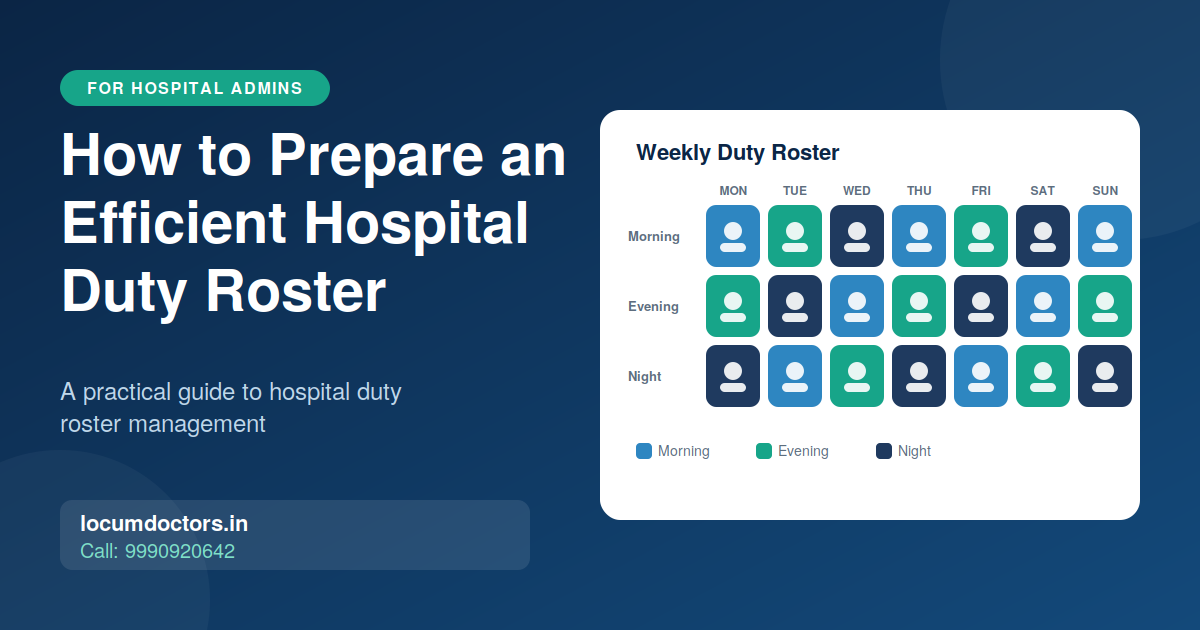
For hospital administrators, hospital duty roster management is one of the most demanding recurring tasks. A poorly planned roster leads to gaps in coverage, exhausted doctors, last-minute panic calls and, in the worst cases, compromised patient safety. A well-planned roster does the opposite. It protects patients, supports staff wellbeing and keeps your operating costs predictable.
This guide walks you through how to prepare an efficient hospital duty roster, from understanding your demand to handling the inevitable last-minute absences.
Why Hospital Duty Roster Management Matters
Before getting into the how, it helps to be clear about what is at stake.
Patient safety: Fatigued doctors make more errors. Rosters that ignore rest requirements directly raise clinical risk.
Staff retention: Unfair or unpredictable schedules are among the top reasons doctors and nurses leave a hospital.
Cost control: Frequent overtime, emergency call-outs and agency bookings at short notice quickly inflate the payroll.
Regulatory and legal compliance: Working hours, rest periods and departmental staffing norms must be respected.
Hospital reputation: Long waiting times and unattended wards are visible to patients and families, and they talk.
Good rostering is not clerical work. It is an operational strategy.
Step 1: Understand Your Demand Before You Assign a Single Shift
The most common rostering mistake is copying last month’s schedule and adjusting a few names. Efficient rosters start with demand, not with names.
Study the following for each department:
Patient footfall patterns: OPD peaks, admission trends, and emergency surges by day of the week and time of day.
Bed occupancy and acuity: An ICU with ventilated patients needs a different doctor-to-patient ratio than a general ward.
Surgical and procedure schedules: OT lists drive the need for surgeons, anaesthetists and support doctors.
Seasonal variations: Monsoon-related infections, festival-season trauma and winter respiratory cases all shift demand.
Pull at least three to six months of data, and use it to define the minimum safe staffing level for every shift in every department. This number becomes the foundation of your roster.
Step 2: Map Your Available Workforce
Once you know what you need, document what you have. Create a single, updated record of all clinical staff that includes:
Name, designation and specialty
Employment type (permanent, contractual, visiting consultant or locum)
Registration and credential validity
Preferred and restricted shifts (for example, approved leave or fixed academic commitments)
Maximum weekly working hours
Cross-cover capabilities, such as a physician who can also cover the HDU
This workforce map instantly shows you where you are overstaffed and, more importantly, where you are structurally short. If a department consistently cannot be covered by permanent staff, that is a signal to plan for flexible capacity rather than rely on emergency fixes.
Step 3: Define Clear Rostering Rules and Policies
An efficient roster runs on rules that everyone understands. Document and circulate a rostering policy that covers:
Shift patterns: Morning, evening, night, or 12-hour shifts, and which departments use which pattern.
Maximum consecutive shifts: Limit back-to-back night duties.
Minimum rest period: Define the minimum gap between two shifts, and ensure post-night rest.
Weekly off and holiday allocation: Rotate weekends and public holidays fairly.
On-call rules: Specify response times, on-call compensation and how on-call duty is distributed.
Leave notice period: Set deadlines for leave requests so that the roster can be built with certainty.
Shift swap procedure: Define who approves swaps and how quickly.
When rules are written and transparent, disputes drop sharply. Doctors may not love every shift, but they accept a system they can see is fair.
Step 4: Build in Fairness and Rotation
Fairness is not a soft factor. It is a retention tool. To keep distribution equitable:
Rotate night shifts, weekends and holiday duties evenly across eligible doctors.
Track cumulative totals (nights worked, weekends worked, holidays worked) per doctor over a quarter, not just a month.
Balance experience on every shift. Avoid placing only junior doctors on night duty without a senior on call.
Consider reasonable personal requests, such as exam leave or caregiving responsibilities, and apply the same standard to everyone.
A simple fairness tracker, even a spreadsheet, can prevent resentment from building silently.
Step 5: Match Skills, Not Just Headcount
Having the right number of doctors on duty is not enough. You need the right mix. For each shift, check that:
Every critical area (ER, ICU, labour room, OT) has a qualified specialist or an appropriately trained doctor.
Senior backup is reachable for junior staff.
Specialty-specific cover, such as paediatrics, anaesthesia or orthopaedics, is not left to chance.
Think of the roster as a skills matrix laid over a calendar.
Step 6: Plan for the Unplanned
No matter how carefully you plan, someone will fall ill, an emergency will extend a shift, or a doctor will resign with a short notice period. Efficient hospital duty roster management assumes disruption and builds a buffer.
Maintain a standby pool: Designate a small group of staff as backup on each shift or day.
Keep a bench of external doctors: Having pre-verified locum doctors available means you can fill a gap within hours rather than scrambling through personal contacts.
Create an escalation chain: Define who the duty manager calls first, second and third when there is a gap.
Keep a record of every last-minute change: Patterns of repeated gaps in the same department tell you where permanent hiring is needed.
This is where flexible staffing partners make a measurable difference. Instead of overloading your permanent team or leaving a department thin, you can bring in qualified locum doctors for a shift, a week or a longer assignment.
Step 7: Use Technology Instead of Spreadsheets Alone
Manual rosters on paper or a single Excel sheet work only for very small teams. As your hospital grows, consider rostering software or at least a structured digital system that offers:
Automatic detection of rule violations, such as insufficient rest or double-booked staff
Shift swap requests and approvals on mobile
Real-time visibility of who is on duty, on call or on leave
Leave and attendance integration
Reports on overtime, vacancy rates and fairness metrics
Even if you are not ready for full software, standardise your template, lock the format, and maintain a version history so that everyone works from the latest roster.
Step 8: Publish Early and Communicate Clearly
A roster is only useful if people know it exists. Follow these practices:
Publish at least two to four weeks in advance so doctors can plan their lives.
Share through one official channel, such as a notice board plus a messaging group or app, to avoid confusion.
Highlight changes clearly when a published roster is revised.
Name a single point of contact for roster queries.
Late or unclear rosters are a leading cause of missed shifts and avoidable conflict.
Step 9: Monitor, Review and Improve
Treat your roster as a living process. At the end of every month, review:
Use these insights to refine next month’s roster. Over time, you will see your emergency calls fall and your planning accuracy rise.
Common Mistakes to Avoid
Copy-pasting the previous roster without checking demand
Relying on informal verbal arrangements
Overloading a few dependable doctors because they never say no
Ignoring post-night rest requirements
Waiting until the last minute to arrange cover for planned leave
Having no external backup plan
A Quick Hospital Duty Roster Checklist
Demand data reviewed for each department
Minimum safe staffing defined per shift
Workforce and credentials updated
Rostering policy documented and shared
Night, weekend and holiday duties rotated fairly
Senior backup assigned for every shift
Standby pool and external locum support identified
Roster published at least two weeks ahead
Monthly review completed
How Locum Doctors Can Strengthen Your Roster
Even the best-planned roster can fall short when vacancies, long leaves or sudden demand spikes arise. This is where a trusted locum partner becomes part of your rostering strategy rather than an emergency option.
Locum Doctors helps hospitals fill temporary and short-term doctor requirements quickly, so that your departments stay covered without burning out your permanent team. Whether you need a specialist for a few shifts, cover for extended leave, or a standby bench for peak seasons, having verified doctors available on demand makes hospital duty roster management far more predictable.
Conclusion
An efficient hospital duty roster is built on data, clear rules, fairness and flexibility. When administrators understand demand, define transparent policies, plan for disruptions and review performance regularly, rosters stop being a monthly headache and start becoming a strength. The result is safer patient care, a more satisfied clinical team and a hospital that runs with confidence around the clock.
Need qualified doctors to fill gaps in your duty roster? Visit locumdoctors.in or call us at 9990920642 to speak with our team about locum doctor support for your hospital.
About the author: This guest post is contributed for locumdoctors.in, a platform that connects hospitals and healthcare institutions with qualified locum doctors for flexible, reliable medical staffing.