
14 Nov 2026
Medical Staff: Types, Roles and Hospital Requirements
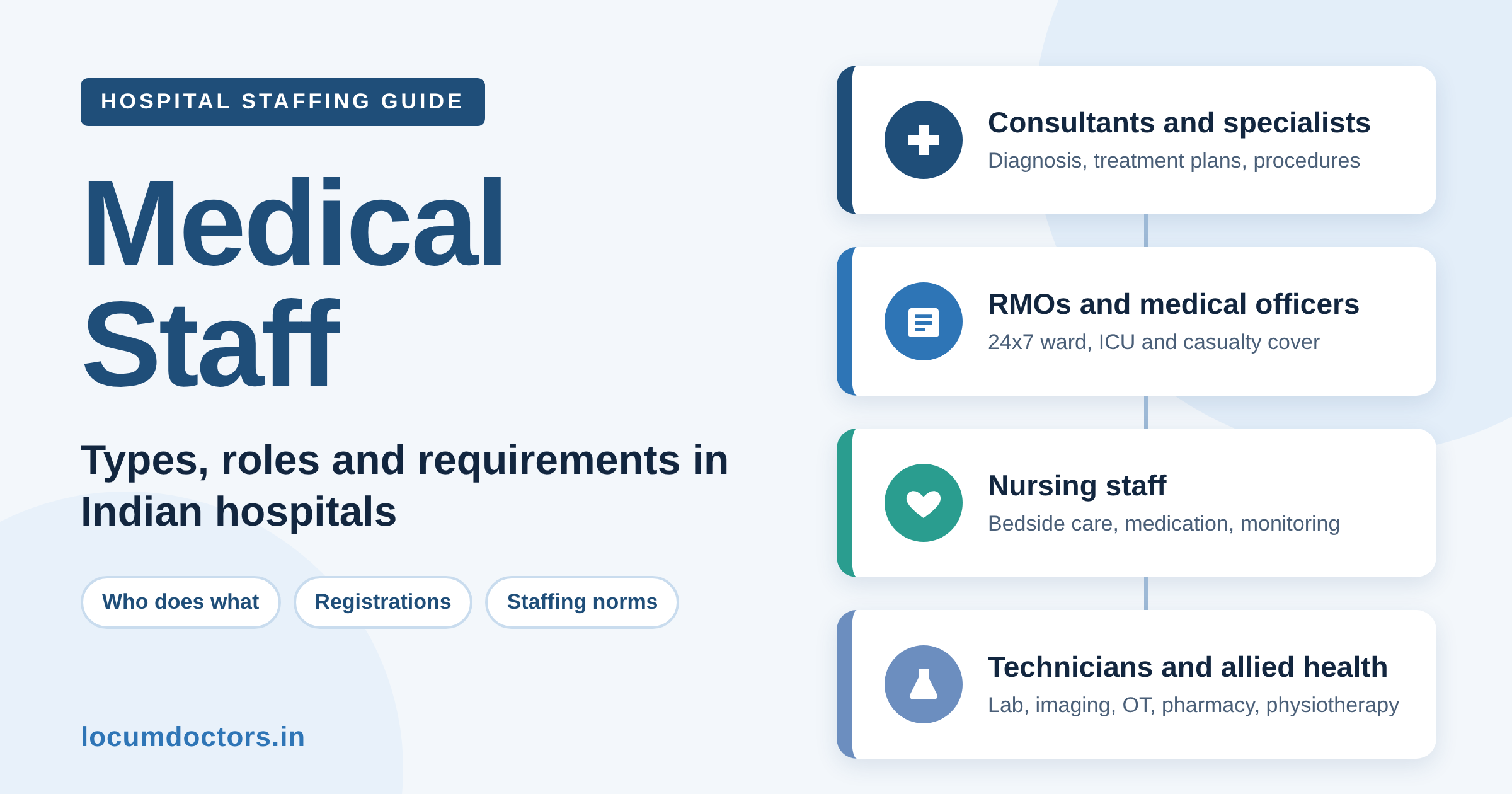
Medical staff are the qualified clinical professionals who diagnose, treat and care for patients in a hospital or clinic. Strictly, the term means doctors with clinical privileges; in everyday Indian usage it usually also covers nurses, technicians, pharmacists and allied health professionals. How many you need depends on bed capacity, patient volume, departments and the services you offer, and every clinician must hold a valid registration for their discipline.
What is medical staff, and why does it matter?
Medical staff are the clinicians responsible for patient care. Hospital governance documents usually mean doctors with clinical privileges. Most Indian job ads and conversations use the broader sense: the whole clinical team. Healthcare staff is wider still and also covers administration, front office, housekeeping, security and IT.
The people on the floor decide the quality, safety and continuity of care, and they are a legal and accreditation requirement.
Where India stands. In a Rajya Sabha reply reported in March 2026, the Health Ministry gave 13,88,185 registered allopathic doctors and 7,51,768 registered AYUSH practitioners. Assuming 80 per cent are available, it estimated the doctor-population ratio at 1:811. It also reported 42.94 lakh nursing personnel registered with the Indian Nursing Council (as of 31 March 2025), of whom about 34.35 lakh are assumed active.
Read this carefully. The 1:811 figure combines allopathic and AYUSH practitioners and is an estimate, not a headcount of working doctors. AYUSH practitioners cannot be deployed in allopathic roles (see the qualifications section). Analysts also argue that distribution across regions and facilities matters more than the national average.
What are the different types of medical staff?
Doctors and physicians: diagnose illness, prescribe treatment and lead clinical decisions. Entry qualification is MBBS, with optional MD/MS/DNB, and registration with a State Medical Council.
Medical Officers (MO): MBBS doctors who typically work fixed OPD or casualty shifts and provide general patient care. They are the backbone of small hospitals and nursing homes.
Resident Medical Officers (RMO) or Duty Medical Officers (DMO): MBBS doctors assigned to continuous cover of inpatient wards and ICUs. They monitor admitted patients, carry out consultant orders, handle emergencies until the consultant arrives and escalate problems. Titles vary between hospitals, but the RMO role is tied to round-the-clock inpatient floor cover.
Specialists and super-specialists: postgraduate (MD/MS/DNB) or super-speciality (DM/MCh/DNB) doctors who work as consultants and heads of department.
Nursing staff: ANM, GNM and B.Sc Nursing professionals who give bedside care, administer medicines, monitor vitals and assist procedures.
Emergency and critical care staff: emergency physicians, intensivists, ICU nurses and paramedics with life-support skills.
Laboratory technicians: collect and process samples and run tests (DMLT or B.Sc MLT).
Pharmacists: dispense and manage medicines, and must be registered under the Pharmacy Act, 1948.
Radiology technicians: operate X-ray, CT and MRI equipment under a radiologist's supervision (see the ultrasound note below).
Operation theatre technicians: prepare the theatre, sterilise instruments and assist surgeons and anaesthetists.
Physiotherapists and allied health professionals: support recovery and rehabilitation. Allied professions now have a national framework under the National Commission for Allied and Healthcare Professions Act, 2021.
Ward attendants, patient care assistants and sanitation teams are essential to hospital operations, but they are classified as non-clinical support staff, not medical staff.
Technicians are legally prohibited from performing ultrasound scans. Under the PCPNDT Act, 1994, ultrasound scans must be performed by registered medical practitioners who meet the Act's qualification requirements, in a centre registered under the Act. Violations can lead to criminal prosecution, imprisonment, fines and sealing of the machine. Technicians may assist with patient preparation and machine setup only. Courts have examined which doctors qualify, including the Madras High Court on AYUSH doctors and the Supreme Court proceedings on the six-month training rule, so check the current position with your state PCPNDT authority.
How is medical staff organised?
The consultant sets the plan, the RMO carries it out and escalates problems, nurses monitor and report, and technicians supply the data decisions rest on.
Who works where: OPD, IPD, ICU, emergency and OT
OPD: consultants or MOs, nurses, registration staff, with lab and pharmacy access.
IPD wards: consultants on rounds, RMOs on every shift, staff nurses, pharmacy and lab support.
ICU: intensivists, trained critical care nurses and respiratory support, with much tighter nurse-to-patient ratios.
Emergency: emergency physicians or casualty MOs, triage nurses, paramedics, fast access to imaging and lab.
Operation theatre: surgeon, anaesthetist, OT nurses and technicians, sterilisation staff and recovery-area nurses.
Roles and responsibilities of medical staff
Diagnosis and treatment: history, examination, investigations, prescriptions, admission and referral decisions.
Monitoring and care: tracking vitals, giving medicines on schedule, spotting deterioration early and handing over clearly between shifts.
Emergency care: triage, stabilisation and resuscitation, backed by current BLS/ACLS training.
Clinical support: imaging, laboratory work, anaesthesia, surgical assistance, physiotherapy and pharmacy services.
Safety and infection control: hand hygiene, sterilisation, safe injection practice and biomedical waste segregation under the Bio-Medical Waste Management Rules, 2016.
Documentation: accurate case sheets, consent forms, discharge summaries and reporting of notifiable diseases.
Medical staff requirements by type of facility
Compliance first. There is no single national staffing formula for private hospitals, but that does not mean there are no rules. Many states regulate inpatient facilities through their own laws, such as the Delhi Nursing Homes Registration Act, 1953, the Maharashtra Nursing Homes Registration Act, 1949 (originally the Bombay Nursing Homes Registration Act), or the Clinical Establishments Act, 2010 where adopted. These can set minimum requirements for qualified doctors and nurses and give authorities power over your registration. Running an inpatient unit without the staff your registration requires can put your licence at risk. Confirm exact requirements with your state health department or registering authority.
Reference nurse-staffing benchmarks
NABH's own hospital application format lists the acceptable standards below, shown here as nurse-to-patient ratios per shift. They are written for empanelment under government health schemes, so accreditation assessments may apply additional guidance. Always confirm with your assessor.
Other Indian benchmarks differ by setting. Critical care nursing guidance linked to the Indian Nursing Council cites 1:1 for ventilated ICU patients and 1:2 for the remaining ICU beds, according to its Nurse Practitioner in Critical Care regulations, and an AIIMS-linked workload study recommended about 1:1.2 for a tertiary-care medical ICU. At Community Health Centre level, the IPHS 2022 CHC volume sets 1:6 for general-ward beds per shift and two nurses per operation theatre per shift.
How to size your team
Beds and occupancy: more occupied beds mean more nurses and RMO cover.
Patient volume: OPD footfall and emergency arrivals set doctors and nurses per shift.
Acuity: ICUs, OTs and labour rooms need higher ratios than wards.
Shift pattern: 24x7 services need several times the single-shift headcount, plus leave and weekly-off cover.
Regulation and accreditation: state rules, NABH and insurance-panel requirements.
What qualifications and registrations are required?
Education: MBBS and postgraduate degrees for doctors; ANM, GNM or B.Sc Nursing for nurses; D.Pharm or B.Pharm for pharmacists; DMLT, B.Sc MLT, imaging or OT technology qualifications for technicians; BPT or MPT for physiotherapists.
Registration is a legal baseline: State Medical Councils for doctors, State Nursing Councils for nurses and State Pharmacy Councils for pharmacists. Experience should match the department, and specialists' postgraduate qualifications should be recognised for the speciality they practise.
AYUSH practitioners cannot be deployed as allopathic doctors. AYUSH practitioners appear in national doctor-population figures, but that is a statistical convention only. The Indian Medical Council (Professional Conduct, Etiquette and Ethics) Regulations, 2002 state in clause 1.1.3 that only a doctor with a recognised qualification, registered with the medical council, may practise the modern system of medicine, and that a person qualified in another system is not allowed to practise it in any form. Some state schemes and court decisions have been cited for limited cross-practice, but they are narrow and contested, and should not be relied on to deploy a non-MBBS doctor as an RMO or in an ICU. Doing so can expose the hospital and its management to negligence liability and to disputes with insurers and TPAs over claims. In Delhi, the Delhi Medical Council has stated that holders of AYUSH qualifications are not entitled to practise modern medicine, and that violations are punishable.
Registration rules are changing. The National Medical Commission maintains the National Medical Register. Its draft amendment of 11 August 2026 proposes a unique identifier for each doctor, nationwide portability of registration and central tracking of licence status and disciplinary records. NMC has also said that obtaining the UID will not cost doctors a fee. As of early November 2026, analysts still described the amendment as a draft that withdrew an earlier April 2026 version. Check nmc.org.in for the current notified position before relying on any of it.
Skills that matter: clinical judgement under pressure, clear handovers and teamwork, patient communication (ideally in the local language), life-support certification where relevant, and documentation discipline.
Common medical staff challenges
Shortages: public-sector gaps can be severe. As one historical example, a CAG audit covering data to March 2022 found Uttar Pradesh short of sanctioned doctors by 38 per cent and nurses by 46 per cent. Private hospitals face gaps in particular specialities and night shifts.
Niche roles: intensivists, anaesthetists, emergency physicians, radiologists and experienced OT nurses are hard to find locally.
Rostering: three shifts, leave and weekly offs mean one unplanned absence can leave a ward or casualty uncovered.
Urgent gaps: resignations, illness or patient surges can create vacancies faster than permanent hiring can fill them.
Retention: night shifts, heavy workloads and limited growth paths push turnover up and disrupt continuity.
How can hospitals recruit and verify qualified medical staff?
Define needs: map each department and shift, and separate permanent needs from variable ones (leave cover, surges, new services).
Source candidates: referrals, associations, job portals and specialist staffing partners.
Verify credentials before duty: check registration on the State Medical Council or national register and confirm active licence status; match qualifications to original certificates; confirm speciality recognition; verify identity; check references; confirm BLS/ACLS for critical areas; confirm indemnity cover where applicable.
Interview and select: combine a clinical discussion with scenarios, and involve the department head.
Onboard properly: issue an engagement letter covering scope, shifts and pay, then run an induction on infection control, emergency codes, documentation and escalation before granting privileges.
Verification is the step most often squeezed when a vacancy is urgent. Any staffing partner you use should pre-verify registration and credentials before introducing anyone. The hospital still owns the final check and the clinical privileging decision.
Which hiring model fits which need?
A locum doctor is a qualified, registered doctor who temporarily covers a vacancy or absence. Use permanent staff for the core of each department, contract or part-time staff for predictable partial demand, and locum cover for unpredictable gaps.
Frequently asked questions
What is the nurse-to-patient ratio in an ICU in India?
There is no single mandatory national figure. NABH's hospital application format lists ICU/ICCU at 1:1. Indian critical care guidance commonly cites 1:1 for ventilated patients and 1:2 for other ICU beds. Confirm the standard your state regulator and accreditation assessor apply.
Can a BAMS or BHMS doctor work as an RMO in an allopathic hospital?
No. NMC's ethics regulations allow only doctors with recognised modern-medicine qualifications, registered with the NMC or a State Medical Council, to practise allopathy. Deploying a non-MBBS doctor as an allopathic RMO risks negligence liability and insurer disputes, whatever narrow state-level exceptions are cited.
Does a hospital need a doctor on duty 24 hours a day?
For inpatient facilities, round-the-clock qualified doctor cover is the norm and is often tied to registration conditions under state nursing home or clinical establishment laws. Requirements differ by state, so confirm with your registering authority.
How many nurses does a general ward need?
NABH's hospital application format lists general wards at 1:6 (one nurse per six beds per shift), and IPHS norms for a Community Health Centre use the same 1:6 figure. Higher-acuity areas need richer ratios, and 24x7 cover needs staff for every shift plus leave reserve.
How can I verify a doctor's registration?
Check the registration number with the State Medical Council or the National Medical Register, confirm the licence is active, and match the name and qualification to original certificates and identity documents. Record the verification before granting clinical privileges.
When should a hospital use locum doctors instead of hiring permanently?
Use locum cover for short, unpredictable gaps such as leave, sudden resignations, night or weekend rosters and seasonal surges. Prefer permanent or contract hiring for roles that need long-term continuity, and ensure locums are verified before their first shift.
Building a Compliant, Resilient Clinical Team
Safe care depends on knowing who your medical staff are, how they are organised, which registrations each role needs and how many people each department genuinely requires. Build the core team with permanent hires, use contract and part-time models for predictable needs, keep a verified flexible option for sudden gaps, and check every credential before anyone treats a patient.
Need a registered doctor at short notice? Share your requirement with LocumDoctors.in.
About LocumDoctors.in: LocumDoctors.in connects hospitals, clinics and nursing homes with doctors for locum, temporary, contract and part-time requirements. Share your speciality, location, shift and duration at locumdoctors.in.
Insights on Hospital Staffing in India
Read more from LocumDoctors.in on how hospitals plan, staff and grow:
Career Medical Officer (12 Nov 2026)
Locum Doctors Within 1 Hour in Delhi NCR (7 Nov 2026)
How to Choose the Best Hospital Staffing Agency in India (26 Oct 2026)
Emergency Doctor Staffing Guide for Hospital Administrators (24 Oct 2026)
How to Prepare an Efficient Hospital Duty Roster: A Practical Guide for Hospital Administrators (23 Oct 2026)
Doctor Recruitment Agency in Delhi NCR: How LocumDoctors.in Helps Hospitals Hire Faster (7 Oct 2026)
How to Find a Temporary Doctor for Your Hospital: A Guide for HR and Medical Superintendents (22 Sep 2026)
Why Small Hospitals Are Losing the Growth Race, and How to Fix It (17 Sep 2026)
How LocumDoctors.in Helps Hospitals Handle Staff Shortages (1 Sep 2026)